Pages

Tuesday, December 16, 2008

2 years


2 years since

you're gone. Absent,

not accounted for.

2 years now,

where are you?

We're still here

2 years later

Saturday, December 13, 2008

Happiness Isn't Fun

This Shabbat's Torah reading, "Ve-yishlach" - the account of how Jacob returns to Canaan and confronts his brother Esau, reminded me of an op-ed by Jonathan Rosenblum I read years ago, Happiness Ain't Fun. Below is an excerpt:


"Each of us is born incomplete. That lack of completion creates a gnawing within. Our natural tendency is to identify that which is missing with something outside of ourselves - material possessions or some physical pleasure - and to make its attainment our goal. Yet attaining the sought-after object rarely does more than stifle the gnawing for a period of time. "

"A moment's reflection would show us why our efforts to quell our inner turmoil are doomed to failure. Our problem is an internal vacuum, but we seek to cure it with things that must of necessity remain external. No physical object can be amalgamated into our being or fill our internal void. But instead of recognizing this, we convince ourselves that we erred only in our choice of objects: We needed a Rolls, not a Cadillac, or two Cadillacs, not just one."

"By focusing on that which is outside of us rather than what is wrong with us, we lose all sense of who we are, what makes us unique, what special tasks we have been created for. Like a teenager whose life revolves around the telephone and the mirror, we lose all sense of ourselves, except as we exist in the eyes of others."

"The soul, which is not of this world, cannot be satisfied with the goods of this world. Only curing our own imperfections can ultimately quiet the ache in our souls, for only such changes as we make in ourselves can be more than momentary sedatives."

"Every material object is, in a sense, borrowed. It cannot become intrinsic to us, part of our essence, and sooner or later it will no longer belong to us. But what we make of ourselves when we conquer our anger or resist the impulse to speak ill of someone else or train ourselves to reach into our pockets for every passing beggar cannot be taken away from us."

" 'Who is a rich man?' ask our Sages. And they answer, 'He who is satisfied with his portion.' They do not say that such a person is also a rich man, but that he is the only rich man. No matter how much a person possesses, he is a poor man as long as he is driven by a hunger for more."

"Upon meeting his brother Jacob for the first time in decades, Esau tells him, 'I have a great deal.'*, implying a desire for yet more. 'Keep it for yourself', Jacob replied, 'I have everything.'** "

* Hebrew: "Yesh li rav" - I have much. (Genesis 33:9)

** Hebrew: "Yesh li kol" - "I have it all. (Genesis 33:11)
Thursday, December 11, 2008

Stigmata

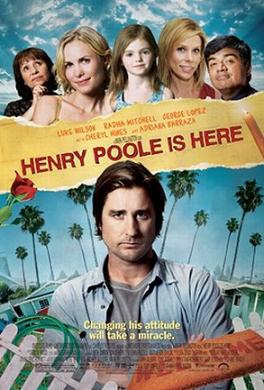
On the way home from America, one of the films featured on our United Airlines flight was Henry Poole is Here. Henry is diagnosed as terminally ill. He quits his job and moves back to the quiet neighborhood where he grew up. He wants to close a circle, to end his days peacefully. He rebuffs his friendly neighbors. Really, what's the point?
.
A nosey neighbor lady is poking around in Henry's back yard and discovers a water stain in the image of Jesus' face on the back of his house. Henry takes a look. He sees a bad paint job. Nevertheless, word gets out and Henry's back yard turns into a local Mecca. The dumb can speak, the blind can see; and Henry couldn't care less.
..

"Hope won't save you", he tells his wellmeaning neighbors. They can't believe it, incredulous that Henry is blind to the miracle staring him in the face.


I have been told that my blogs about movies are spoilers, so I won't go on. Henry Poole is Here is about the eternal three: faith, hope and love; its a thought provoking story with a twist. Just the thing for a Henry Poole like me.


Every now and then you hear about these strange little 'miracles'. Like statues of the Madonna or people bleeding spontaneously from parts of the body where Christ was wounded. (These people are usually Catholics - non Catholics generally go to a doctor when they spontaneously bleed.)

Its called "stigmata". Most people dismiss it as so much bunk, most people not being Catholic. I for one (neither Catholic nor 'most people') buy it. But the question isn't, "Is it true?"; the real one is, "Is it the truth?" After all, that's the conclusion they (the Catholics) would have you come to.


My mother in law's father died once. In fact, he was so dead that they had him all wrapped up in a shroud for burial. (People weren't buried in coffins back then, over there in Bombay.) Fortunately, he came back to life before they got around to burying him. Once his wife calmed down, he told this story:

After he died, he was taken down a hallway to a place and "there was a trial". He was asked if he had any requests. He replied that his youngest daughter Rosy was to be married soon and that he wished he could have lived to see her married. At this point he found himself back among the living, wrapped up in the shroud.

In the monthes that followed until Rosy's wedding the old man told his story to a number of people. He wasn't sick any more. Rosy got married and about a week afterwards he was sitting outside on a balcony or a porch and his wife left him for a moment. She heard him say, "What, you've come already?" By the time she came back to see who he was talking to, he was already gone.


What does it mean?

Not much, really, unless you happen to be a member of the family. At the time it meant a lot to my mother in law, her brothers and sisters. It was a bit of comfort in their time of loss, but there are no spiritual truths here.
.
Stigmata is a Catholic thing. It happens to Catholics, it strenthens Catholics, it gives them a little hope. I'm sure the bizzare, gory stories are true, but that doesn't mean it has anything to do with the truth. God, for reasons only He knows, sometimes does things a little out of the ordinary. Not to prove this religion or that; it's His way of encouraging people. A little miracle here and there gives people hope.
.
No, Henry, hope won't save you. Not always. But you can take this to the bank; if you don't have any hope at all, you're already finished.

Thursday, December 04, 2008

Letter from America: Paradise

San Francisco, California
Sunday, November 30, 2008

A week or so before I set out for America, we read the story of creation from the Torah scroll in our synagogue. It goes like this: God creates a paradise, and lets a man and a woman live there. He gives them free will, a choice. This freedom is the man and woman's undoing as they end up choosing to eat fruit of a tree forbidden them and are sent out from Eden.

The United States of America was founded by 13 colonies on the Atlantic coast and over the space of less than a century expanded westward to the Pacific Ocean. On a bay at frontier's end is San Francisco.

The city is a monument to the achievement of the human will over the elements. She is built on a peninsula connected to the mainland by the Golden Gate Bridge suspended on enormous cables and further south by more bridges that run for miles over the bay. San Francisco was the perfect place to build a deep water harbor, but her steep hills would have normally precluded it as a site to found a city. Undeterred, the city fathers overcame the obstacles in their way. The famous trolleys made it possible to climb hills too steep for horse and carriage and homes were built almost one on top of the other. At the mercy of frequent earthquakes, they have built skyscrapers designed to stand even the most violent quakes. But more striking than the city's victory over the physical elements is the diversity of the population; Asian, African, Hispanic and European descendants make up the indigenous population.

My friend Mary lives in a quiet suburb on the bay just south of the city. Mary is one of my favorite Americans. I've known her since seventh grade and we've kept in touch over the years. My daughter Maayan and I visited her on the last leg of our journey in America. She took us to see her sister Barbara who lives in the city.

Barbara lives with an obese cat she rescued from the animal shelter in a building called 'The Thick House'. It's like a kibbutz for artists. Each of the residents is in some way an artist; poets, painters, sculptors. They display their creations in the hallways and stairwells of the building that is in itself a work of art.
.
..
..

.
. .
Barbara wasn't always an artist. Thirty years ago she was my boss in the men's department at JC Pennys where I worked while I was in college. After 20 years in the retail business, she chose to recreate herself in the middle of life and learn a new craft. Artists usually use their art to express themselves, but Barbara is different. She is a graphic artist that works for the city's public library. She has the gift of reaching into the mind of another person and creating images that can be understood by others. She is like a translator using a visual language.

Mary's family is a metaphor for what I think is most beautiful about America. Mary is the almost youngest of seven brothers and sisters. Each and every one is dramatically unlike the other, each a different hue of opinion, occupation, lifestyle, and personality. Yet as a family they are a rainbow, close and harmonious, accepting and appreciative of one another.

What is America? It is the ongoing fusion of the entire gamut of the human race into one nation. This truth, self-evident, that all men were created equal was a stone big enough to bridge the gulf that divides people and peoples, and to built on it a new civilization founded on tolerance.

America is a paradise. A paradise created by human beings out of the only thing man took with him when he was sent out of the Garden of Eden – freedom. Freedom to be what and whom they will regardless of race or religion or age or gender. Freedom may be America's undoing, but without it Americans wouldn't be who they are.

Americans have a choice.

Letter from America: Black Friday

Friday November 28
Seattle, Washington

We Israelis don't lack for anything we need, but we don't always have everything we want.

Israelis in America get sick. It's an eye disease. We see all the newest brands and latest models. America is shiny and glittery, and on sale. We Israelis see this and get big eyes.

They call the day after Thanksgiving 'Black Friday'. It isn't because the day is dark or evil. It got its name because retailers open the holiday shopping season with sales and since most Americans have the day off the stores are swamped by shoppers and it puts them 'in the black'.

Black Friday can be deadly for Israelis that happen to be in America. In this climate, their immune system is weak anyway, and the glitter of gadgets is too bright and the prices too appealing to resist. Israelis can't help but shop and spend.

But with all the plenty glaring on the surface, it's easy to miss a different reality underneath. Americans tell me about the high prices they have to pay to own their own homes. They go into debt to pay for their children's education and while medical care is state of the art, its price has become exorbitant and beyond the reach of many. I was shocked to discover that American businesses aren't required to provide their employees with pensions.

I listened to Americans and it struck me how poor little Israel has managed to provide low interest mortgages to young families and immigrants, tuition is maintained at a reasonable level (2,500 dollars by law, regardless of the level of the institution one attends.) and all enjoy the benefits of our national health system for a fraction of what it costs Americans.

So I didn't get up early on Black Friday to fight my way through the crowds to the great sales. I'm not dazzled by American trinkets. When it comes to the things that are really important, it seems to me that we Israelis are better off than our American cousins.


We Israelis don't have everything we want; but as for the things we need, we have it all.
Sunset over the Sea of Galilee; the day is almost done and the way back home in sight.