Monday, December 19, 2011
jesus@yahoo.com
Wednesday, June 23, 2010
Playing on Passion
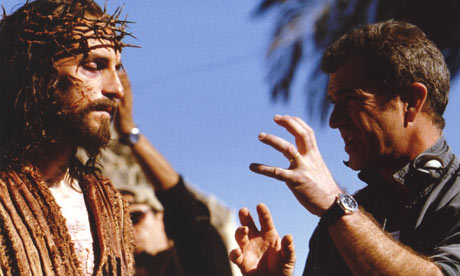
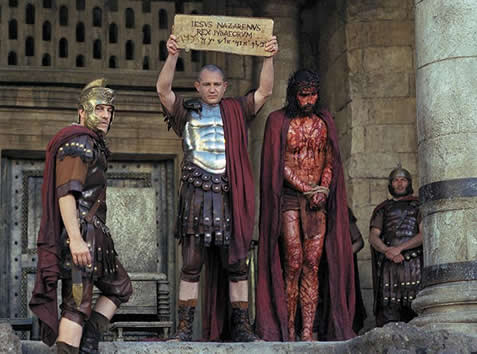
Gibson gambled in both The Passion and Apocalypto, presenting historical drama in contemporary languages to subtitle-illiterate Americans, counting on raw violence and a fast pace to retain their attention. The Passion of the Christ is almost docudrama, following Jesus on his Via Dolorosa ("way of sorrow") in the last hours before his crucifixion. Apocalypto takes place in the doomed Mayan civilization literally moments before the arrival of the Spanish conquistadors.
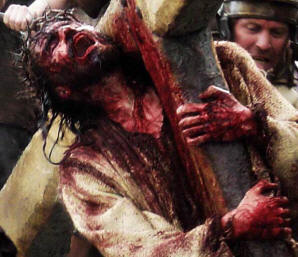
Human sacrifice plays on passion. By our very nature, we can't help but be moved when observing the ritual murder of another person. So I have to agree with the verdict of the Jewish audience on this one, even if not with their polemics. Gibson's Passion is fueled by the same raw emotion that turned the wheels of idolatry and Papal violence, reducing Jesus' crucifixion to no more than another version of paganism. The Passion of the Christ is only a modern rendition of an ancient universal genre, one that has tugged at human hearts, sometimes literally, since the dawn of time.
Gibson could have featured the gory crucifixion of any one of thousands of Jews 2000 years ago and would have generated the same emotion. The cross doesn't make Jesus the Messiah.
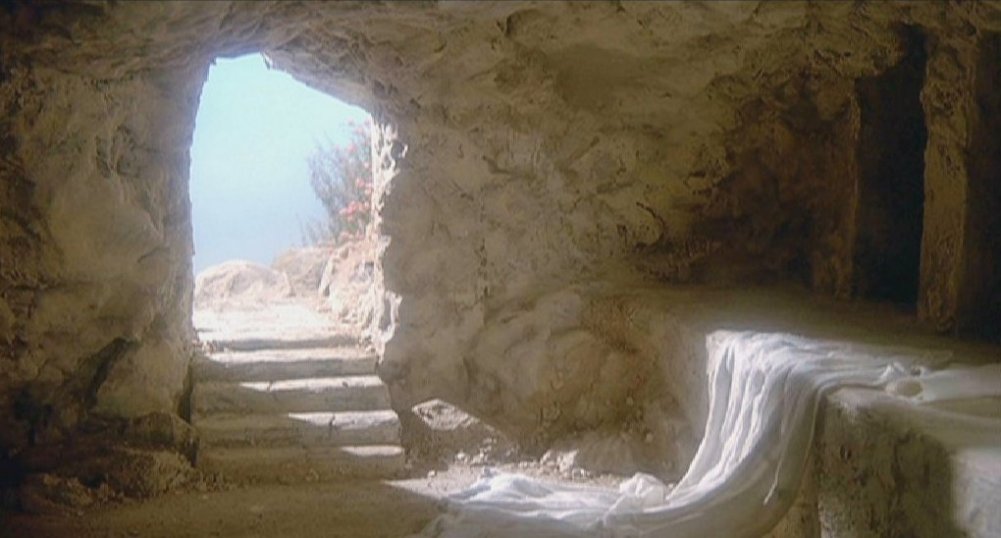
In the last 60 seconds of the Passion, Gibson takes us to a tomb. The stone rolls away and the camera pans over to an empty shroud. Jesus comes into focus, stands and the last we see of him is a nail-pierced hand. An empty grave doesn't play on emotion and it won't generate box office hits, but it makes all the difference between victim and Messiah.
Saturday, June 12, 2010
A Bad Joke
The Rabbi observes this and orders something from the menu. When all have dined, they ask for the check. The priest refuses to pay up – all he had was a glass of water. The minister puts down a few coins for the roll and sardine. The rabbi tears the bill in half and says, "May the God who divided the Red Sea for the Children of Israel split this bill between this pair of fools."
A bad joke. Not really funny. But like any joke or story there is some truth in it, otherwise it doesn't make sense. True, there is interfaith tension. True, the Jewish stereotype is wily and greedy, not that there's any truth to the stereotype itself.
.
There is a measure of truth to William Paul Young's "The Shack". His story is about Mackenzie who grieves his 6 yr. old daughter, who was kidnapped and probably murdered in a shack in the Wallowa Mountains by the 'Little Ladykiller', a perverted serial killer. 4 years on, Mack gets a mysterious message from 'Papa', family nickname for God, inviting him to return to the same shack his daughter was killed.
The story is Young's venue to outline his views on religion. Much of Young's theology is sketchy, but he's explicit at least on one pillar of Christianity: the trinity. Mack goes to the shack, and indeed meets God, who is:
.
.
1. God the Father ("Papa") is a woman, black, fat and in the kitchen. So, there you have it ladies and gentlemen, God looks like this:
2. Jesus. He's not what Mack expected.
"Jesus?"
"Yes Mackenzie?"
"I am surprised by one thing about you."
"Really? What?"
"I guess I expected you to be more" – be careful here, Mack – "uh…well, humanly striking."
Jesus chuckled. "Humanly striking? You mean handsome." Now he was laughing.
"Well, I was trying to avoid that, but yes. Somehow, I thought you'd be the ideal man, you know, athletic and overwhelmingly good-looking."
"It's my nose, isn't it?"
Mack didn't know what to say.
Jesus laughed. "I am Jewish, you know. My grandfather on my mother's side had a big nose. In fact, most of the men on my mom's side had big noses."
"I just thought you'd be better looking."
(From "The Shack")
.
.
.
.
God (namely, God the mother) is essentially the defendant. Why do bad things happen to good people? Or namely, why did God let Mack's blameless daughter experience such a brutal fate? Papa's answer is that instead of sparing her, Jesus was there for her, sharing her suffering, comforting her. The story about Jesus and the imaginary girl is heart warming, but what about real people that are terrified and alone and in pain?
There is a measure of truth to Young's arguments, but the bottom line is that he deals with hard questions by not really answering them. His story rings true and pleasant to the ear, but falls apart the minute it hits reality. The gospel according to Young is that mankind is undergoing an educational process, Jesus was an object lesson; if we can only understand God and his plan enough, all things are resolved. I'm just wondering if a god that can be understood by humans is really God.
You will find many interesting ideas in The Shack. Some of them are true and by sifting them from Young's inventions, the reader can reexamine himself and build a stronger foundation for his/her faith.
It's hard to pin Young down on anything other than his concept of the trinity, which leans more three than one. At very least he has done a great service for detractors of Christianity who claim it's not a monotheistic religion. The Shack is exhibit A for the commandment forbidding making an image of God. Young has made God in the image/images of man/men/women, creating his gods from racial profiles I hoped had passed from this world 50 years ago (the Negro mammy, the inscrutable oriental and the ugly Jew). In the end, Young's gods are small, no larger than his imagination, and their images limited to ethnic stereotypes.
Mack walks into The Shack and meets God – an African-American woman, an Asian and a Jew. It sounds like a bad joke; if only it were.
Monday, June 07, 2010
kissing the mirror
.
"Every time I finish a story, there is a little relief, a sense of release. In every story I give up something and in return I receive something.... With each story I am being healed and the scales fall from my eyes and the glass becomes clearer and I can see."
(from "Losing Control at a Very Basic Level")
I got the idea for the title from one of my stories. One of the girls I dated in high school told me she practiced kissing on the mirror. It struck me that it's a metaphor for those things we often do innocently, with the best of intentions, but in the end don't get us any where with God. And in a way, it's also like our human nature, sinful and self-centered. Until we realize the vanity of kissing the mirror, we will never experience the real thing with God.Saturday, August 29, 2009
Torn Between Two Women

Most are at least familiar with the account of Mary queen of Scots' imprisonment and execution at the hands of her cousin Elizabeth I, but a less known tale is that of the relationship that developed between Mary and her host/jailer, George Talbot, Earl of Shrewsbury, and his wife Bess of Hardwick. Philippa Gregory breathes life into this historical footnote in her novel, "The Other Queen".
A sincere man of honor, George accepts Elizabeth's charge to hold Mary as his unwilling guest, but in the style she is accustomed. His wife Bess is less than enthusiastic about the prospect of entertaining royalty.
Two women under one roof – big mistake.
.
.
Bess is a "much married woman". She describes herself as "self-made" and has made a career of bettering herself through strategic marriages and then helping her spouses rob the Catholic Church which is being dismantled by the Protestants that have seized control of England. By marrying husbands above her station and then carefully husbanding the profits, she successively gains leverage to yet better matches in turn. George is her fourth, the crown of her achievements, joining his noble blood with her new money in a blend that mixes well with the cream of Elizabethan society.
Mary has been to the alter more than once herself, but that's where the resemblance to Bess ends. She is the product of careful breeding and carries in her person the keys to power, a "queen three times over" heiress to the thrones of Scotland, England, and France. Raised as a princess, she takes the trappings of royalty for granted and holds court even in captivity, at the expense of her hosts. Bad enough for ol' Bess that has slaved for every penny, but what gnaws deeper is having a woman said to be the most beautiful in Christendom and half her age to boot sharing her "husband the earl's" attentions.
Indeed, George the jailer is captured by his prisoner's charm and torn between Mary and his wife, the lady of the house out ranked by her guest. He's an honorable man, so there's no question of loyalty. On the contrary, he is played by both women. He tries to make Mary feel as welcome as possible under the circumstances, but she returns by exploiting his goodwill to hatch ever new plots to recruit spies and allies to overthrow her rival. And Bess for her part thinks nothing of spying on her husband and the "other queen" for Elizabeth's henchmen.
On the canvas of 16th century England's religious struggles, Gregory has painted a metaphor of those two bridesmaids of Christ; the Catholic Church and that peculiar invention, the Church of England. Catholic Mary has the pedigree and holds court in grandeur. She's beautiful and glamorous, but has the heart of a harlot and seduces men to rebellion and death. Bess is the Anglican. She serves a bastard queen, a self-made religion conceived in lust by Henry VIII and nursed with greed by Elizabeth I, robbing Catholic sacraments and Protestant reformation to cloth herself in legitimacy. She thinks she's fooled everyone, but even her own husband sees a common thief underneath the trappings of nobility.
And George is the Bridegroom. Grieved and deceived by Mary's scheming and Bess' grubbing, he turns his back in sorrow on both. As if to say, in the words of the poet in Elizabeth's court, "A plague on both your houses."
.
Saturday, December 13, 2008
Happiness Isn't Fun
"Each of us is born incomplete. That lack of completion creates a gnawing within. Our natural tendency is to identify that which is missing with something outside of ourselves - material possessions or some physical pleasure - and to make its attainment our goal. Yet attaining the sought-after object rarely does more than stifle the gnawing for a period of time. ""A moment's reflection would show us why our efforts to quell our inner turmoil are doomed to failure. Our problem is an internal vacuum, but we seek to cure it with things that must of necessity remain external. No physical object can be amalgamated into our being or fill our internal void. But instead of recognizing this, we convince ourselves that we erred only in our choice of objects: We needed a Rolls, not a Cadillac, or two Cadillacs, not just one."
"By focusing on that which is outside of us rather than what is wrong with us, we lose all sense of who we are, what makes us unique, what special tasks we have been created for. Like a teenager whose life revolves around the telephone and the mirror, we lose all sense of ourselves, except as we exist in the eyes of others."
"The soul, which is not of this world, cannot be satisfied with the goods of this world. Only curing our own imperfections can ultimately quiet the ache in our souls, for only such changes as we make in ourselves can be more than momentary sedatives."
"Every material object is, in a sense, borrowed. It cannot become intrinsic to us, part of our essence, and sooner or later it will no longer belong to us. But what we make of ourselves when we conquer our anger or resist the impulse to speak ill of someone else or train ourselves to reach into our pockets for every passing beggar cannot be taken away from us."
" 'Who is a rich man?' ask our Sages. And they answer, 'He who is satisfied with his portion.' They do not say that such a person is also a rich man, but that he is the only rich man. No matter how much a person possesses, he is a poor man as long as he is driven by a hunger for more."
"Upon meeting his brother Jacob for the first time in decades, Esau tells him, 'I have a great deal.'*, implying a desire for yet more. 'Keep it for yourself', Jacob replied, 'I have everything.'** "
* Hebrew: "Yesh li rav" - I have much. (Genesis 33:9)
** Hebrew: "Yesh li kol" - "I have it all. (Genesis 33:11)
Thursday, December 11, 2008
Stigmata
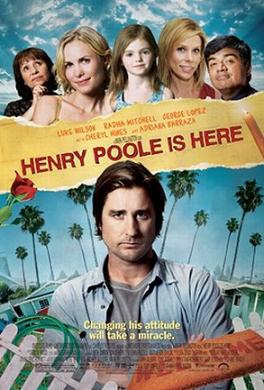
On the way home from America, one of the films featured on our United Airlines flight was Henry Poole is Here. Henry is diagnosed as terminally ill. He quits his job and moves back to the quiet neighborhood where he grew up. He wants to close a circle, to end his days peacefully. He rebuffs his friendly neighbors. Really, what's the point?.
A nosey neighbor lady is poking around in Henry's back yard and discovers a water stain in the image of Jesus' face on the back of his house. Henry takes a look. He sees a bad paint job. Nevertheless, word gets out and Henry's back yard turns into a local Mecca. The dumb can speak, the blind can see; and Henry couldn't care less.
..
"Hope won't save you", he tells his wellmeaning neighbors. They can't believe it, incredulous that Henry is blind to the miracle staring him in the face. I have been told that my blogs about movies are spoilers, so I won't go on. Henry Poole is Here is about the eternal three: faith, hope and love; its a thought provoking story with a twist. Just the thing for a Henry Poole like me.
Every now and then you hear about these strange little 'miracles'. Like statues of the Madonna or people bleeding spontaneously from parts of the body where Christ was wounded. (These people are usually Catholics - non Catholics generally go to a doctor when they spontaneously bleed.)
Its called "stigmata". Most people dismiss it as so much bunk, most people not being Catholic. I for one (neither Catholic nor 'most people') buy it. But the question isn't, "Is it true?"; the real one is, "Is it the truth?" After all, that's the conclusion they (the Catholics) would have you come to.
My mother in law's father died once. In fact, he was so dead that they had him all wrapped up in a shroud for burial. (People weren't buried in coffins back then, over there in Bombay.) Fortunately, he came back to life before they got around to burying him. Once his wife calmed down, he told this story:
After he died, he was taken down a hallway to a place and "there was a trial". He was asked if he had any requests. He replied that his youngest daughter Rosy was to be married soon and that he wished he could have lived to see her married. At this point he found himself back among the living, wrapped up in the shroud.
In the monthes that followed until Rosy's wedding the old man told his story to a number of people. He wasn't sick any more. Rosy got married and about a week afterwards he was sitting outside on a balcony or a porch and his wife left him for a moment. She heard him say, "What, you've come already?" By the time she came back to see who he was talking to, he was already gone.
What does it mean?
Not much, really, unless you happen to be a member of the family. At the time it meant a lot to my mother in law, her brothers and sisters. It was a bit of comfort in their time of loss, but there are no spiritual truths here.
.
Stigmata is a Catholic thing. It happens to Catholics, it strenthens Catholics, it gives them a little hope. I'm sure the bizzare, gory stories are true, but that doesn't mean it has anything to do with the truth. God, for reasons only He knows, sometimes does things a little out of the ordinary. Not to prove this religion or that; it's His way of encouraging people. A little miracle here and there gives people hope.
.
No, Henry, hope won't save you. Not always. But you can take this to the bank; if you don't have any hope at all, you're already finished.
Sunday, November 02, 2008
In Bruges
Here and now.
By the time Jesus came along the idea of "there and then" had evolved. He wasn't challenged when He spoke of life after death. (Except for the Sadducees who were old farts that nobody cared about anyway.)
Talmudic Judaism and the early Church developed the idea of the next world; the resurrection, Judgment Day, heaven, hell. Of course this presented a new problem. If there is a day of judgment then, and people are living and dying now, then where are the souls in the meantime? Lets say that Joe died in the year 1000 AD and Judgment Day is only in the year 2000 AD. (Theoretically of course, because who could have imagined that God would tarry so long.) What happens to Joe for a thousand years?
The Jews, or at least the more mystically inclined, decided that Joe is here. After he died he got a second chance and a third and so on. He got reincarnated to make a "tikkun", to fix things he'd screwed up in his former life. His soul would "roll over" (the term for reincarnation in Hebrew) again and again until he got it right. The soul, so they said, is definitely here and now.
The Christians, more specifically the Catholic ones, invented something new. When Joe died his soul went to a place called Purgatory where he worked off any unsettled accounts with God until Judgment Day. According to the Catholics, after the body dies the soul is there and then.
It is this nagging question about the time and place between the debts we accrue in life and payday that is at the heart of the film "In Bruges". Two Irish gangsters are sent to Bruges, Belgium after botching a hit in London. They are told to wait there for instructions, but at least to Ken, the older of the two, its clear that there will be a reckoning.Bruges is a well preserved Medieval European town, "something out of a fairytale" one of the thugs calls it. Ken is more aware than his mate of their predicament and in no hurry, but young Ray chafes in exile. He is tortured by guilt and oblivious to the charm of Bruges. He wants to move on, not knowing that here and now is all he has left.
Bruges, a place in between, after life but before judgment.
The great sage Maimonadies understood something that eluded others, both Jewish and Catholic. Time and place are created. God doesn't exist in time or place, and when we leave this life our souls are no longer bound by either. We don't have time to kill until "then"; we don't roll back over and over again "here".
"In Bruges" is a black comedy with an irony that makes sense in a daft mad Irish state of mind. The setting and hints like the painting "The Last Judgment" by Hieronymous Bosch (Note how grotesque characters like in the painting appear throughout the film.) point to something deeper. If there is such a thing as purgatory, its here and now. Ray wallows in guilt, but does nothing about it. Ken finds a way to redeem himself.
Bruges – a fairytale land or a tortured conscience in exile. Bruges, untouched by time, is where we are, where we will be. Heaven and hell don't begin when this life ends. For the soul there is no boundary between "here and now" and "there and then".
So maybe the Old Testament prophets were right after all. The next life starts now.
Ray: "Prison...death...didn't matter. Because at least in prison and at least in death, you know, I wouldn't be in ****in' Bruges. But then, like a flash, it came to me. And I realized, **** man, maybe that's what hell is: the entire rest of eternity spent in ****in' Bruges. And I really really hoped I wouldn't die. I really really hoped I wouldn't die."
From "In Bruges"