Pages

Showing posts with label movies. Show all posts

Saturday, December 25, 2010

The Seventh Tear


There's something enchanting about the Irish, an inconsistent combination of melancholy and melody, mad mentality that's logical only if Irish or inebriated. Or both. Words spill off their tongues singsong like music. Fairytales and fact intertwine until its hard to tell where one ends and the other begins.
.
Neil Jordan's Ondine (Ireland, 2009) is an ancient legend in 21st century Ireland. Syracuse, locally know as "Circus", is a fisherman that finds a girl in his net. He's not sure if he's lost his senses, but his daughter Annie is certain that his catch is a selkie, a Gaelic version of mermaid. Syracuse humors Annie, but her interpretation of the myth proves to be closer to reality than common sense. There's no denying that when she sings to the fish, his catch is unheard of. The Fisheries Inspector is incredulous when Syracuse claims he caught salmon trawling (apparently only possible with a gill net), but astounded to find Ondine hiding under the (dry) gill net.

Fisheries Inspector: "Circus, there's a girl in your net!"
Syracuse: "Is that illegal?"
Fisheries Inspector: "No, but it's unusual."
Syracuse: "Ask her how I caught the salmon."
Fisheries Inspector: "How did he catch the salmon?"
Ondine: "Trawling."
Fisheries Inspector: "Do you expect us to believe fairytales?"
Ondine: "Yes."
.

Neil Jordan deftly weaves legend together with a modern story employing imagery and symbolism. It's fairly easy to find the connections if you listen carefully to little Annie's explanation of selkies. They are seals who shed their fur to live with men. A man who hides a selkie's fur for seven years can keep her, a selkie who sheds seven tears can find happiness with her landsman. Syracuse is beside himself, wanting to believe in happily ever after, but afraid that it's too good to be true.


So what is real? What we know or what we believe?

Wednesday, June 23, 2010

Playing on Passion

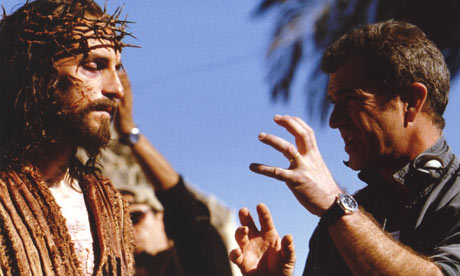
Somewhere along the line Mel Gibson evolved from talented actor to serious artist. His career crawled out of the organic matter of blood and guts in the Mad Max series to action/comedy in Lethal Weapon I-IV, and in the last decade or so made the leap to a new level of thought provoking work, directing "The Passion of the Christ" (2004) and "Apocalypto" (2006).


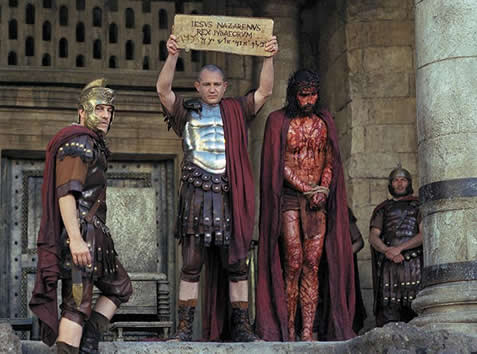
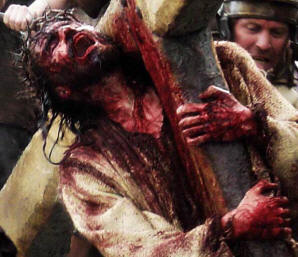
Gibson gambled in both The Passion and Apocalypto, presenting historical drama in contemporary languages to subtitle-illiterate Americans, counting on raw violence and a fast pace to retain their attention. The Passion of the Christ is almost docudrama, following Jesus on his Via Dolorosa ("way of sorrow") in the last hours before his crucifixion. Apocalypto takes place in the doomed Mayan civilization literally moments before the arrival of the Spanish conquistadors.


The Passion of the Christ isn't officially censored in Israel, but in tacit consent between the local distributors and the Israeli audience it isn't marketed here. (I was only able to see it on Utube.) It's just a modern version of Medieval passion plays once produced by the catholic church, more often than not the spark igniting drunken riffraff only too willing to exact revenge on the local Jewish community. At least that is how it's seen here. And besides, a crucifixion isn't going to move an Israeli crowd – in Second Temple Judea it was almost death by natural causes.

Objectively speaking, the telling of Jesus' crucifixion is certainly legitimate, even essential for Christians. Gibson's version isn't blatantly anti-Semitic, but he slips a latent bias in between the lines. He washes Roman hands of guilt; a reluctant Pilate who issues the death warrant, and the ignorant bullies who drive in the nails – Gibson forgives them for they know not what they do. He places the Christ's murder squarely on the Jews; if it's sanctimonious priests scheming and manipulating others to do their dirty work, or a lynch mob screaming for blood. But to be honest, Gibson's portrayal of Jews is accurate. The first century Jewish leadership was never accused of being 'nice' by their contemporaries, and Judeans weren't a gentle bunch, as Roman legions would discover time and again. Saying that, let me remind any Christians latching on to the above "admission of guilt" in order to browbeat present day Jews 2000 years removed from the crime, according the gospels it was first and foremost Jesus orchestrating the events that lead to his crucifixion – otherwise he isn't who he says he is and he was simply the sad victim of a case of mistaken identity. And as for Jewish kneejerk defensiveness at any mention of Jesus, we won't erase anti-Semitism by repainting the past.

In Apocalypto, an idyllic indigenous village in the jungle is raided and its inhabitants force-marched to a city belonging to a more advanced Mayan civilization. The story focuses on the captive Jaguar Paw, following him from his abduction on through the frenzied Mayan crowd. After the women are auctioned off, the men are painted blue and led up to a temple where one by one their beating hearts are to be cut out to ensure the pleasure of the gods and a good harvest. Jaguar Paw's life is spared by a total eclipse of the sun (a sign of the god's favor) and he exploits the opportunity to make a break for the jungle. He is doubly fortunate, for just as his pursuers catch up with him on the beach, they meet a landing party of armored Spaniards and priests who appear to them as gods, to Jaguar Paw (and Mel Gibson) as saviors.

It's not hard to decipher Gibson's agenda from his work; it's apologetics for the traditional catholic church, with one hand pointed at Christ killers, and the other twisting a positive spin on the Spanish crimes of conquest (and subsequent forced catholic conversion) of the native population of Central America. But it is in the parallels and contrasts between the two films one can find the fallacy in Gibson's portrayal of Jesus' crucifixion.


In Apocalypto, men are made gods to be sacrificed to save the Mayans from famine; in The Passion it is God made flesh to save men. Both films pivot on celestial signs, the solar eclipse vis-à-vis God darkening midday to night. In both the spectators - the Mayan crowd or modern theater audiences - are riveted to the drama of human sacrifice. And there's the rub.


Human sacrifice plays on passion. By our very nature, we can't help but be moved when observing the ritual murder of another person. So I have to agree with the verdict of the Jewish audience on this one, even if not with their polemics. Gibson's Passion is fueled by the same raw emotion that turned the wheels of idolatry and Papal violence, reducing Jesus' crucifixion to no more than another version of paganism. The Passion of the Christ is only a modern rendition of an ancient universal genre, one that has tugged at human hearts, sometimes literally, since the dawn of time.


Gibson could have featured the gory crucifixion of any one of thousands of Jews 2000 years ago and would have generated the same emotion. The cross doesn't make Jesus the Messiah.


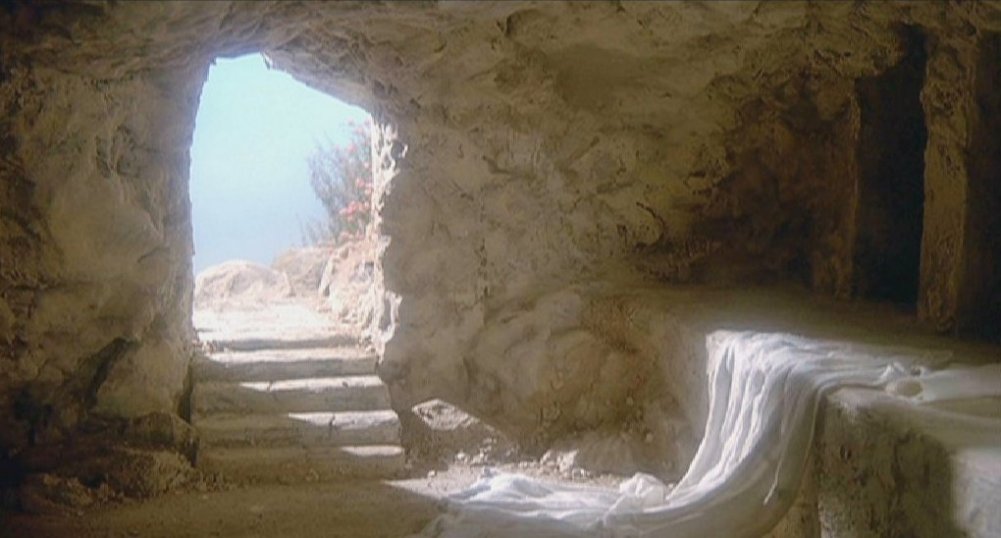
In the last 60 seconds of the Passion, Gibson takes us to a tomb. The stone rolls away and the camera pans over to an empty shroud. Jesus comes into focus, stands and the last we see of him is a nail-pierced hand. An empty grave doesn't play on emotion and it won't generate box office hits, but it makes all the difference between victim and Messiah.

Monday, May 25, 2009

More Than The Matrix

(With school, tax time and summer, I haven't been able to free my mind and my schedule to blog anything new. Shavuot (Pentecost) is here, and More than the Matrix seems to be in the spirit of the holiday.)


Netanel and I are into The Matrix trilogy. For those who haven't seen or at least heard of it, it's about Neo who is a cyber messiah, mankind's last hope in the face of a race of robots that sustains itself by turning human beings into living batteries. It's a kind of alternate energy nightmare.


Neo has the perfect life. His day job is hacking into the robots' network ("the Matrix") and playing the ultimate computer game on line, beating up bad guys that look like grown ups in business suits. After a hard day of kicking the crap out of adults on line, Neo retires to human kind's secret underground base ("Zion") with his hot babe and they go to this great trance party.


"Mr. Smith", a personified antivirus program inventing by the robots to protect the Matrix from hackers like Neo that has shorted out and is running amuck. Out of control and driven by hatred for humans and robots alike, Smith becomes a menace to one and all.

Morpheus, the prophet that discovered Neo, is convinced that he will save mankind. In the end, Neo martyrs himself for the sake of humankind (and robotkind) in a classic 'good triumphing over evil' battle, and defeats Smith.

Humans and robots, now friends, are all grateful and The Matrix ends with the promise of a brighter tomorrow for everyone.

But what then? Do they have a party? And what about the computer games?

Did the Israelites think their deliverance from Egypt was a cosmic version of The Matrix? There was this big bad villain and God saved them with lots of special effects and pyrotechnics. Did they figure that they were free to pursue their own devices? Because that's what they did.

Just as soon as that old fuddy-duddy Moses had his back turned and was busy hammering the Ten Commandments out of stone on the mountain, they rigged up a golden calf and had a trance party.

They didn't get it. God didn't free them from the flesh pots of Egypt to set up new ones of their own. Salvation is an opportunity to start a life that means something. God expected more of them. And He expects more of us.

Passover is not only about freedom from slavery, but also about liberating ourselves from the Egypt within. About finding more in life than pleasure and self gratification.

I don't think that Neo gave his life in order that those he left behind could carry on hacking into 'The Matrix' and partying like there's no tomorrow. He died to give them a chance to build a new world; one with meaning. Not a virtual simulation on a computer program, but a real life with substance.


Neo wanted humans to live like he lived, to love like he loved.

Neo expected more of men than The Matrix.


Saturday, April 25, 2009

Nimrod's Children

"Therefore is the name of it called Babel; because the LORD did there confound the language of all the earth: and from thence did the LORD scatter them abroad upon the face of all the earth." (Genesis 11:9)

Mexican film director Alejandro González Iñarritu is the movie industry's version of Pablo Picasso, chopping up stories and rearranging them without regard to time or space in a collage as cryptic as one of the Spanish artist's creations. While the method is engaging, unless one is blessed with an unusual memory, you need to see Iñarritu's films twice to really understand what you've seen.

Babel is four stories filmed on three continents in four languages which seem to have little or nothing in common at first - Moroccan goatherds in the Atlas mountains, an American couple on vacation, a Hispanic woman and her young charges at a wedding in Tijuana and a rebellious teenaged deaf/mute in Tokyo. What's the connection? Chance; seemingly insignificant details are the butterfly wings that blow a tempest once their consequences are felt on the other side of the globe.

Images of children in the book of Genesis are interwoven into the plot. The rivalry between Cain and Able, Ishmael abandoned to die in the desert, Lot's seductive daughters; the common denominator being the tragedy of characters driven by emotion and their flawed nature to unpredictable, if rational, consequences.

Babel isn't a film friendly to subtitle illiterate Americans, but one I recommend. Not because of the story(ies), rather so that you see for yourself that such a movie can exist. Save for the few human beings on this planet that are fluent in all four languages - English, Spanish, Japanese and Arabic – Babel would have been incredible and unintelligible only a generation or so ago.

Man has broken down the barriers of distance and language that have separated the human race with the power of the mind. Technology. After four or five millennia, Nimrod's children have once again built a city, a global village, and a tower. Iñarritu's Babel is a sample of the mortar between the bricks.

"And they said, Come, let us build us a city and a tower, whose top may reach unto heaven; and let us make us a name, lest we be scattered abroad upon the face of the whole earth." (Genesis 11:4)

Friday, January 30, 2009

Alaska

A bit of trivia, but not a bit trivial, is the fact that I was born in the state of Alaska. It's a wild country, but my parents weren't thrill seekers. The most adventurous thing they've ever done was to marry each other; a close second was having me. Anyway, I wasn't in Alaska very long. My parents and I left when I was a year and a day old.

I have always been a bit intrigued by the land of my birth. I grew up in Oregon, which is a beautiful place, but to be brutally honest – it's kinda boring. I heard the call of the wild at an early age. I daydreamed about adventure, imagined setting out on my own and dancing with danger.

Sean Penn's film 'Into The Wild' was a natural choice for me when I saw it on the shelf at the movie rental place. It is the true story about Christopher McCandless. Raised by well-to-do, upper middle class peppermint Americans, his story is not remarkable until he graduated from college, donated his savings to charity and set out west in a beat up Datsun. Severing his ties with his family, he chooses a new name, 'Alexander Supertramp'; and cutting society's safety net he burns the last of his spare cash.

The new self made 'Supertramp' lives on the edge. He hobos freight trains, starves with the homeless in urban America and survives dehydration in the desert. He has this amazing adventure where he paddles a kayak down the Colorado River to the Gulf of Mexico, and then with no documents and a winning personality, fast talks himself back over the border. Every time he's reached the end his rope, dumb luck and the kindness of strangers snatch him from the jaws of calamity.

But its not enough for McCandless/Supertramp. His dream is to walk into the wild back country of Alaska and live off the land like his hero Jack London.

So I'm watching Into The Wild and thinking to myself, "If I were young, if I could do it all over again, this is exactly what I'd do." And then it occurred to me that that is exactly what I did. I left everything and everyone behind for a life I invented in an exotic and dangerous place close to the edge. I even did the name change thing.

Christopher hitched his way north to the Stampede Trail in central Alaska in April of 1992. He headed into the bush with a 22 caliber rifle and 10 pounds of rice and set up a base camp in an abandoned bus. At first he holds his own, but when he realizes that he isn't hunting and gathering enough to sustain himself he decides to hike out – only to discover that he's trapped by white water currents of a river that had been frozen over when he hiked in. Trapped in the wild by his own folly, Christopher McCandless starved to death.


Unprepared by spoilers, it hit me hard. Like McCandless, lust for adventure consumed me in my youth. I set out into the wild, and in a way I'm trapped there.

It's not something uncommon. Young men and women (probably more men than women) hear the call of the wild, singing like Sirens luring sailors to peril. You want life to mean something, to experience it in the extreme. You want to taste it raw and bleeding, not boiled and seasoned like it was served at home.

Many have answered the call of the wild. Most of us live to tell about it. My journey took me to the other side of the planet. I thought I could make up a name, invent a life of my own. I lived on a kibbutz and enlisted in the Israeli army. And by the time I realized what I had done, it was too late. An ocean of reality separated me from where I had come from.

McCandless and I aren't uncommon. Many young men hear the call. I have a cousin who 'disappeared' years ago. He was just a kid when I left America, a bit rowdy but likeable enough. He got in trouble here and there, but nothing too serious. And then he took off and nobody's heard from him since save for cryptic messages every now and then. Here in Israel, trekking into the wild is almost a rite of passage for young men and women after they finish their army service. Most of them find their way back, although I've heard more than one parent comment that even though they are back here, they're still over there.

If you walk into the wild and can't find your way back, you're lost. You live a life to the Nth degree and discover yourself, but the only ones that care are back where you started from.

I'm one of those that returned. I still live in Israel, but I'm a member of my American family. It involves long distance telephone conversations and flying for hours between continents, but the bottom line is that I came back. Home is where the heart is, and so is the wild. You can be on the other side of the globe or just around the corner, but when finding yourself means cutting yourself off from the ones that love you, you're lost in a wilderness.

I hope my cousin will find his way home someday. I think that if McCandless could have made it out of Alaska, he would have returned to his family. Weak and helpless, he wrote this on a page torn from a novel in hopes that someone would find it in time.

"S.O.S. I need your help. I am injured, near death, and too weak to hike out
of here. I am all alone, this is no joke. In the name of God, please remain to
save me."

It was signed, "Christopher McCandless". Not Alexander Supertramp. He was ready to come home, but it was too late.

The state of Alaska is where my life began; its where Christopher McCandless's ended. The wild isn't a place as much as a state of mind. Some of the less fortunate get trapped there; most of us adventurous souls are lucky enough to find our way home.

Thursday, December 11, 2008

Stigmata

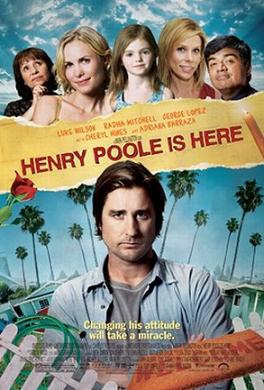
On the way home from America, one of the films featured on our United Airlines flight was Henry Poole is Here. Henry is diagnosed as terminally ill. He quits his job and moves back to the quiet neighborhood where he grew up. He wants to close a circle, to end his days peacefully. He rebuffs his friendly neighbors. Really, what's the point?
.
A nosey neighbor lady is poking around in Henry's back yard and discovers a water stain in the image of Jesus' face on the back of his house. Henry takes a look. He sees a bad paint job. Nevertheless, word gets out and Henry's back yard turns into a local Mecca. The dumb can speak, the blind can see; and Henry couldn't care less.
..

"Hope won't save you", he tells his wellmeaning neighbors. They can't believe it, incredulous that Henry is blind to the miracle staring him in the face.


I have been told that my blogs about movies are spoilers, so I won't go on. Henry Poole is Here is about the eternal three: faith, hope and love; its a thought provoking story with a twist. Just the thing for a Henry Poole like me.


Every now and then you hear about these strange little 'miracles'. Like statues of the Madonna or people bleeding spontaneously from parts of the body where Christ was wounded. (These people are usually Catholics - non Catholics generally go to a doctor when they spontaneously bleed.)

Its called "stigmata". Most people dismiss it as so much bunk, most people not being Catholic. I for one (neither Catholic nor 'most people') buy it. But the question isn't, "Is it true?"; the real one is, "Is it the truth?" After all, that's the conclusion they (the Catholics) would have you come to.


My mother in law's father died once. In fact, he was so dead that they had him all wrapped up in a shroud for burial. (People weren't buried in coffins back then, over there in Bombay.) Fortunately, he came back to life before they got around to burying him. Once his wife calmed down, he told this story:

After he died, he was taken down a hallway to a place and "there was a trial". He was asked if he had any requests. He replied that his youngest daughter Rosy was to be married soon and that he wished he could have lived to see her married. At this point he found himself back among the living, wrapped up in the shroud.

In the monthes that followed until Rosy's wedding the old man told his story to a number of people. He wasn't sick any more. Rosy got married and about a week afterwards he was sitting outside on a balcony or a porch and his wife left him for a moment. She heard him say, "What, you've come already?" By the time she came back to see who he was talking to, he was already gone.


What does it mean?

Not much, really, unless you happen to be a member of the family. At the time it meant a lot to my mother in law, her brothers and sisters. It was a bit of comfort in their time of loss, but there are no spiritual truths here.
.
Stigmata is a Catholic thing. It happens to Catholics, it strenthens Catholics, it gives them a little hope. I'm sure the bizzare, gory stories are true, but that doesn't mean it has anything to do with the truth. God, for reasons only He knows, sometimes does things a little out of the ordinary. Not to prove this religion or that; it's His way of encouraging people. A little miracle here and there gives people hope.
.
No, Henry, hope won't save you. Not always. But you can take this to the bank; if you don't have any hope at all, you're already finished.

Sunday, November 02, 2008

In Bruges

The prophets probably didn't know about the afterlife, and even if they did they certainly didn't tell anyone. There's no mention of heaven or hell in the Old Testament. Salvation, judgment, redemption were collective and in this life.
Here and now.

By the time Jesus came along the idea of "there and then" had evolved. He wasn't challenged when He spoke of life after death. (Except for the Sadducees who were old farts that nobody cared about anyway.)

Talmudic Judaism and the early Church developed the idea of the next world; the resurrection, Judgment Day, heaven, hell. Of course this presented a new problem. If there is a day of judgment then, and people are living and dying now, then where are the souls in the meantime? Lets say that Joe died in the year 1000 AD and Judgment Day is only in the year 2000 AD. (Theoretically of course, because who could have imagined that God would tarry so long.) What happens to Joe for a thousand years?

The Jews, or at least the more mystically inclined, decided that Joe is here. After he died he got a second chance and a third and so on. He got reincarnated to make a "tikkun", to fix things he'd screwed up in his former life. His soul would "roll over" (the term for reincarnation in Hebrew) again and again until he got it right. The soul, so they said, is definitely here and now.

The Christians, more specifically the Catholic ones, invented something new. When Joe died his soul went to a place called Purgatory where he worked off any unsettled accounts with God until Judgment Day. According to the Catholics, after the body dies the soul is there and then.

It is this nagging question about the time and place between the debts we accrue in life and payday that is at the heart of the film "In Bruges". Two Irish gangsters are sent to Bruges, Belgium after botching a hit in London. They are told to wait there for instructions, but at least to Ken, the older of the two, its clear that there will be a reckoning.

Bruges is a well preserved Medieval European town, "something out of a fairytale" one of the thugs calls it. Ken is more aware than his mate of their predicament and in no hurry, but young Ray chafes in exile. He is tortured by guilt and oblivious to the charm of Bruges. He wants to move on, not knowing that here and now is all he has left.

Bruges, a place in between, after life but before judgment.

The great sage Maimonadies understood something that eluded others, both Jewish and Catholic. Time and place are created. God doesn't exist in time or place, and when we leave this life our souls are no longer bound by either. We don't have time to kill until "then"; we don't roll back over and over again "here".

"In Bruges" is a black comedy with an irony that makes sense in a daft mad Irish state of mind. The setting and hints like the painting "The Last Judgment" by Hieronymous Bosch (Note how grotesque characters like in the painting appear throughout the film.) point to something deeper. If there is such a thing as purgatory, its here and now. Ray wallows in guilt, but does nothing about it. Ken finds a way to redeem himself.

Bruges – a fairytale land or a tortured conscience in exile. Bruges, untouched by time, is where we are, where we will be. Heaven and hell don't begin when this life ends. For the soul there is no boundary between "here and now" and "there and then".

So maybe the Old Testament prophets were right after all. The next life starts now.


Ray: "Prison...death...didn't matter. Because at least in prison and at least in death, you know, I wouldn't be in ****in' Bruges. But then, like a flash, it came to me. And I realized, **** man, maybe that's what hell is: the entire rest of eternity spent in ****in' Bruges. And I really really hoped I wouldn't die. I really really hoped I wouldn't die."

From "In Bruges"

Friday, July 25, 2008

Peppermint Americans

This last year I took a lot of pictures of our 9th graders. Hundreds of them. Every chance I had – in the hall, on breaks, on hikes and overnight trips – I captured them. They don’t get it yet, but when they graduate, they'll want these memories.

One kid asked me why I do it and I told him. "You're optimistic", He said, "who says we'll be alive in 4 years?"

He's referring to Iranian President Mahmoud Ahmedinijad's promise to wipe the Jews off the map of the Middle East just as soon as he gets nuclear weapons. This year, or the next, Iran will start producing an atomic bomb. This generation's mad dictator, cross-eyed and dressed in cheap suits, is spelling out the next Holocaust every bit as plainly as the funny little man with the little mustache did in Mein Kampf. How much time is left? Will our 9th graders finish school before they graduate?

I don't know how most Americans respond to what's happening on my side of the world. It must be a little overwhelming.


Israel, Palestine, Iraq, Iran, Darfur, Tibet, Myanmar, Congo.

Terror, Poverty, Ethnic Cleansing, Starvation, Torture, Hatred, Rape, Death.

I can imagine that it can be too much in Safe, Sensitive, Sensible, United, States, of America.

Some Americans - not all, not even most, but a few - live in a Hollywood happy-end musical. Good wins over evil, and everyone is happy and perky. They are Julie-Andrews-Marias on a stunningly beautiful, but isolated, mountaintop and the hills are alive with the sound of music. And if things are nasty down there at the bottom of the hill, well, they just remember their favorite things and then they don't feel so bad.

......"Raindrops on roses and whiskers on kittens,
......Bright copper kettles and warm woolen mittens,"


Like, if they concentrate on the good, if they take in the beauty around them and listen, yes, listen to the music, they can heal the world. Sure, there is pain, but there is beauty; listen, just listen to the sound of music.

How did Arundhati Roy (The God of Small Things) describe cheery Rodgers and Hammerstein Westerners?

Clean, white children, "like a packet of peppermints".

"The house they lived in had a lake and gardens, a wide staircase, white doors and windows, and curtains with flowers."

"…… Baron von Trapp's seven peppermint children had had their peppermint baths, and were standing in a peppermint line with their hair slicked down, singing in obedient peppermint voices ……."

What about the children on my side of the world? What about children that have dark skin and brown eyes? What if they're frightened and hungry and have grubby fingers? Peppermint Americans sound out of tune and their peppermint songs are off key on my side of the world. They are smug, snug and complacent. They can't heal anything, certainly not my least favorite things.

......Hunger and hatred and ethnic cleansing,
......Rape and starvation and nuclear testing,

This side of the world is a tough neighborhood, and bullies get away with murder around here. I don't know what will be this year, or the next; I don't know if our 9th graders will graduate from high school. I don't know what Americans are supposed to do about it, but somebody better do something and they better do it fast.

And I know this: peppermint Americans and their peppermint songs won't make evil go away. Don't tell us how much you care about the misery over here, and then in the next breath about listening to your pretty peppermint music and how then you don't feel so bad.

When the mad dictator's henchmen were one step behind the peppermint von Trapp kids, even Maria knew that it wasn't the time to sing about her favorite things.

Monday, July 07, 2008

Elizabeth

The feature films "Elizabeth" and its sequel, "Elizabeth - The Golden Age", are the Indian born Shekhar Kapur's portrayal of Queen Elizabeth I of England.


.
.
.
.
.
.
.
.
.
.


Elizabeth may be called fortunate. As a young woman she narrowly escapes execution at the hand her Catholic sister Queen Mary, and towards the end of her life she and her throne are spared by the destruction of the Spanish Armada, and throughout her life she survives various plots to assainate and/or overthrow her.

The young Elizabeth is determined that the house of Tudor will rule sovereign, but faces three impediments; religious strife at home, powerful enemies abroad and a bankrupt treasury. A young woman playing in an old men's courts, she deftly shatters the obstacles in her path with one blow. Or actually two. With the Act of Supremacy she places herself, and all English monarchs to this day, at the head of the church her father created in order to divorce his first wife Catharine and marry Elizabeth's mother Anne Boleyn; and with the Act of Uniformity she tries to dance at two weddings. She reckons that this new improved Church of England retains enough sacraments to be Catholic, but shorn of fealty to Rome it will satisfy her Protestant subjects.

Hoping that she has united the nation behind her and with new income from property confiscated from the Catholic clergy and nobility that opposed her, she presumes that she is safe. Not so.

The real Catholics aren't fooled and when she executes her cousin Mary Queen of Scots, she's crossed one red line too many. Her enemies set out to punish her, and in the end it is only the bravery of her sailors and the caprice of a storm that sweep the Armada out to sea, that saves Elizabeth and England.
.
Despite not being English, or perhaps because of it, Kapur breathes life into Elizabeth. His is not only the tale of a great queen, but the story of a bright and beautiful girl that sacrifices her femininity and eventually her humanity for the sake of the greater good and her family's name. Elizabeth is said to have been the best educated and most intelligent woman of her day, yet in her determination she pushed aside all that stood in her way. She couldn't tolerate those who didn't applaud her and turned a deaf ear to others' opinions.
.
In the end, all that was in the grail was vanity. Elizabeth ended her days a lonely, bitter old lady mourning her womanhood.
.
Perhaps the greatest irony of all is that in spite of all her efforts, Elizabeth was nevertheless the last of the Tudors. She spent her last days in the company of polital cronies that knew how to manipulate her with flattery, and when she died, James I, the son of her arch rival Mary Stuart (Queen of Scots), succeeded her to the throne.

Tuesday, July 01, 2008

My Teaching Gig

I prepared a "rainy day" presentation (an activity for two or more classes which can used on short notice in case one or more English teachers call in sick and no substitute can be found.)

The idea is this: first show them an excerpt from the Vin Diesel action comedy "The Pacifier" (Walt Disney, 2005) and then another clip from "The Sound of Music" (20th Century Fox, 1965), and finally discuss the connection between them.

Huh? Connection?


.


.


.


.

The Pacifier is a US Navy SEAL officer sent to care for and protect the children of widow Julie Plummer (Get it? Julie Andrews + Christopher Plummer). This is a twist of the Sound of Music, where the nun Maria is sent to be the governess for the children of Captain (Navy, get it?) von Trapp. The tough commando and the kids don't hit it off, but he ends up falling for them and they pick up combat tactics (As opposed to Maria teaching the von Trapp kids to sing.)


Now you have to understand; I got this teaching gig totally by accident.


Six summers ago I was a farmer and gardener between jobs, and our high school needed an English speaker to fill in for a real teacher on Sabbatical. I didn't have a clue what I was going to do with my students when I walked into a classroom that first day of school; and when the year was over and they had actually made progress, I hadn't the foggiest how I had done it.

I wasn't a very good teacher. The kids gave me hell and I don't think I've ever given a proper lesson. I hated grades, which for me are meaningless numbers, and discipline because I'm not a disciplined person. I was so bad at teaching that I up and quit in the middle of my second year.

But something had happened. The kids had gotten under my skin. So I came back as a volunteer. At first I was with the English staff, tutoring and helping out. Then I caught up with "my kids", who were in 11th grade by now, and joined their homeroom staff. I went with them on their field trips and sleepovers and chaperoned their parties.

Then last year a very special girl, Neta, was all mine. She was just a hair away from expulsion when I asked to take her under my wing. I don't know how it came to me, but I decided that Shakespeare is just the thing for a student that is failing almost everything and is weak in English. And she made it, if just barely.

This year, last year's 12th grade homeroom staff started a 4 year journey with the freshmen, the 9th graders I blog about. I asked to again teach, with a real class with real grades, for just one year. I wanted to get to know the kids and the kids to get to know me. And by now I knew what would happen. I fell in love with them.

For the next 3 years I will travel with them until they graduate and go to the army and out into life. Yesterday they got their report cards and started their summer vacation. I can't wait to see them again next September.


I think what stays with everyone that has seen The Pacifier and The Sound of Music is how Maria teaches the von Trapp's music and how Lt. Wolfe (Vin Diesel) trains the Plummer kids in hand to hand combat, and how the kids change and blossom. But how many remember that no less remarkable is how the children changed Maria and the tough Navy SEAL? But I noticed. Because that's what happened to me.

.
I'm not a very good teacher. I'm not even a real teacher. I don't know what my student learned from me, or if they learned anything, and if they did, how I did it. I don't know how many of "my kids" will remember me. Well, I suppose Neta will.

But I know this; I will remember them all.

Saturday, June 28, 2008

A Big Fat Jewish Wedding

Before Yael and I got married, her brother Yehudah asked me to come with him on an errand. It seemed innocent enough and I agreed. He drove me out into the marshes in Haifa's harbor district where poisoned streams of industrial waste flowed in canals by factories and the electrical power plant. The perfect place to dump a body.

He started talking about Yael, and told me what a stand up girl she was, and that he would hate for her to get hurt. Coming from a hairy, muscled Mediterranean guy like Yehudah, the message was clear.

Obviously, I did the right thing without further persuasion. I discovered later that while Yehudah is a little wild, he's not violent and the ride in the marshes was a practical joke.

Yael's family is a big one. When they are together there's noise and confusion and lots of good Indian food (Her parents came to Israel from Bombay). And do the math. Yael is one of six brothers and sisters which all have at least three kids each and if you take in account cousins and nieces and nephews, that adds up to a lot of weddings and brises and Bar Mitzvahs.

Yael and I saw "My Big Fat Greek Wedding", a comedy about a girl of Greek-American extraction that falls in love with a regular WASP kind of guy. The story hinges on the contrast between her colorful and spicy family and the groom to be that is as bland as "toast" according to the girl's mother. All through the movie Yael and I laughed and our eyes would meet; the movie was about us!

Weddings Greek, Jewish, Israeli, or Indian – they are all variations of the same genre of loud and crowded chaos.

And to be honest, I am toast. I like quiet, I like tranquil, I like boring. I hate big, fat Jewish weddings. Once I told my brother Barry about an up coming (Yael) family event. I was all pushed out of shape because they were putting a lot of pressure on me to go.

Barry was taken aback by my stick in the mud attitude.
"You're lucky enough to have people who go out of their way to invite you to share their celebration, to spend time with you - and you're angry about it?!!"
As usual, Barry has a point. Yael's family pays me the highest compliment; they want me to be part of their family. And I'm not in the mood to party with them.

Being toast is chutzpah.

There's this parable about how God is like this guy throwing a big, fat Jewish wedding. He sends out invitations, but everyone in town are toast. They have better things to do, they're busy, they have excuses. They blow the guy off.

The guy doesn't cancel the wedding. He invites the poor and the beggars, and they all have a great wedding. It turns out that this guy is a pretty serious dude, kinda like the goon Yehudah pretended to be. He punishes all the people that didn't bother to come to his wedding.

The moral of the story is that God pays us the greatest of compliments. He offers to let us be part of His family, and if the invitation is the greatest of favors, then blowing it off is the greatest of insults.

What I'm wondering is this. What about toast? What about a guy like me that doesn't like big, fat Jewish weddings, but shows up anyway? What about someone that goes to the wedding, but can't wait for it to be over already?

What does God do about toast?

Monday, June 23, 2008

Out with Irene

Barry gave us the movie Blackhawk Down on CD a few months back and since then Netanel has played it dozens of times, sometimes even as background noise while he's on the computer or studying for a test. .
.

As war movies go, Blackhawk Down is just about as realistic as it gets without getting shot at. It's all there – a senseless mission, the snafus, the command detached from reality or humanity - soldiers getting screwed more by their thickheaded officers than the enemy, commanders in the field (generally NCOs) that save their men from above mentioned officers and enemy alike.


In the autumn of 1993 US Rangers and Delta Force had been dropped into the middle of a civil war between Somali warlords with the naïve idealistic objective of restoring order. On October 3, Operations issued orders for a questionable daring mission codenamed "Irene" to apprehend hostiles in the heart of Mogadishu, but a series of mishaps on the ground and breakdowns in communications end up with the Rangers under siege with critically wounded casualties and isolated units scattered in a city stirred and swarming.

At this point, I want to clarify that my qualifications as a military analyst are from the ground up. In my 26 years in Israeli army uniform, I have never been more than a crewman of an M-109 self propelled howitzer. My crew has never fired a live round at a live person, not even during the 2006 war in Lebanon (Because our battalion's new crop of crew commanders fresh from regular enlisted service were unable to make heads or tails of the outdated equipment we have in reserve battalions and the 670th was declared "unfit for combat" that summer.)

The Israeli Army is ever short of infantry for duty on the borders and on the West Bank, so a good 80 to 90 percent of my service over the years has been as a foot soldier far from my beloved howitzer. I've been out with "Irene" a few times.

"Irene" was your garden variety abduction operation in enemy territory (called "an arrest" by the military). I've participated in a few "arrests" over the years, if on a much smaller scale. In an operation like this you have 3 units:

1. The attack team. This unit makes the arrest and is as small as possible with the best soldiers available. Few so they don't get in each others way, best so that they don't shoot each other or the arrestee by mistake.


2. The isolating unit; to prevent anyone from coming to the aid of the arrestee.

3. The extraction force, by far the largest of the three, remains out of the picture but ready to come to the aid of the first two units should something go south during the operation.

Delta was the obvious choice to enter and apprehend, and Rangers lowered from Blackhawks were assigned to isolating the site. The extraction force was a convoy of (Rangers?) on Hummers.

What went wrong?

Surprise is essential. Going in at high noon, "Irene" depended on the speed of its helicopters to compensate; but since evacuation was on wheels, dealing with an armed response was inevitable.


Using the Blackhawks to achieve fire superiority over the city made them more or less static elements of the isolation force. Since their main advantage is fire in motion, they became sitting ducks.

Ideally, the attack and isolating units leave the scene independently. Assigning the extraction force with evacuating detainees with their captors meant that there was nothing left in reserve in case something went wrong. When the convoy got lost in the city, evacuation was delayed, compounding the fiasco.

Another thing about the movie is how you see the Rangers more or less ignoring the Somalis shooting at them. This is pretty accurate. You have "suppressive fire", which isn't really meant to kill anyone but just to get the other guy to take cover; and "effective fire" when you shoot through sights in hopes of actually hitting someone. The Somalis were using a third kind of fire which is called "making a lot of noise, but not hitting much of anything except innocent Somalis". The difference between "effective fire" and shooting off your gun is the big difference between Hizbullah fighters and gun toting Palestinians.

Netanel and I watch the same movie, but we're not looking at the same thing. Our points of view are from different places in life. "Irene" for me is just one more screw up, only on a much grander scale than any I have participated in. Here in Israel, more often than not the guy you're after isn't home and nobody is eager to risk dear life to get him.

For Netanel it's different. It's starting to sink in; before you know it he will be in uniform and on his way to "Irene". He's started asking questions, technical questions; picking the brain of that old soldier, Abba.

But for me, if anything is harder that going out with "Irene", it will be those three long years when Netanel will be out there with an "Irene" of his own.

Thursday, June 12, 2008

Grease is the Word


I was secretly pleased when my 13 year old Odelia asked me to rent out the movie "Grease". To the best of my memory, it was a wholesome light hearted 50's style musical, much better fare than the shallow sexually explicit Hip Hop ghetto fare shes been into lately.

Either my memory or my better judgement failed me this time. Grease is the story of how Sandy, an intelligent poised young lady from Australia, hooks up with a handsome dark stranger (Danny) over the summer, and much to her delight it turns out that he is an old hand at her new high school. The only thing is that her beau is a shallow bully who's interest in the "land down under" has nothing to do with Geography.

Sandy is at first disappointed, but Danny sincerely wishes to clean up his act and even cuts down to two packs a day and signs up for the track team. But Danny's heart isn't really set on scoring on the field and Sandy has to make a choice, and she does. In the end, she shows up and much to the delight of Danny and his loser cronies, she's every bit a slut as her arch rival Rizzo.

The moral of the story: Girls, if you have a mind and some character, you'll miss the dream-boat. He's only interested in tying up to a dingy. But if you lower your standards to the lowest common denominator and pretend that you don't have anything of value above the waist, well, by golly your ship will come in and everybody will love you.

Sometimes I'm glad that English isn't Odelia's mother tongue. While she's smart enough to pick up on the plot, most of the crude inuendo and not-inuendo went right over her head.

What was I thinking!?!!!!!

And what more, how did "Grease" pass my parent's strict Fundamentalist G-rated-only censurship? And I hear there is a Grease revival bringing in new converts daily; how is it that feminists world wide aren't up in arms?

"Grease" runs just about 180 degrees against everything I want for Odelia. It is a dramatization of the dilemma she faces these days; to make the most of the brilliant mind and gifted imagination God gave her, or to submit to the dictates of the bimbo brainless babes that rule Junior High.

Thank you, Hollywood. Now I have another mess to clean up.

Odelia asked me what "Grease" means.

"Oh, it's something goopy and slimy that's hard to wash off."

Sunset over the Sea of Galilee; the day is almost done and the way back home in sight.